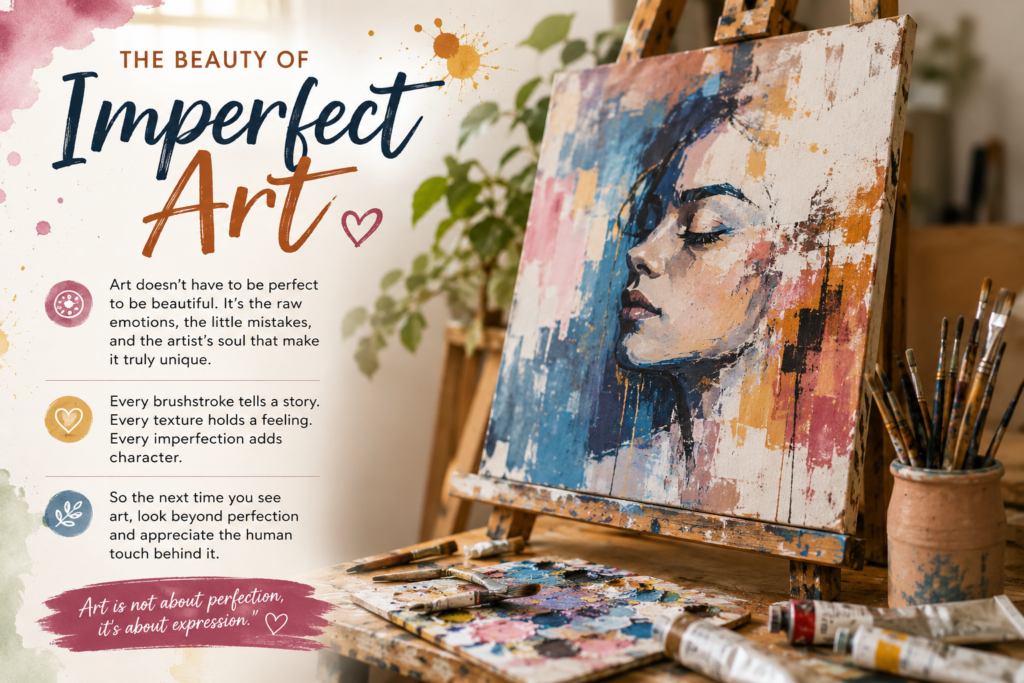
The Beauty of Imperfect Art
When we look at a beautiful painting, we often notice the colors, the details, and the way everything seems to fit perfectly together. But have you ever stopped to think about the little mistakes in that artwork?
Maybe a brushstroke is slightly uneven. Maybe a color has spread where it wasn't supposed to. Maybe a part of the painting looks unfinished.
And yet, somehow, the artwork still feels beautiful.
That is the beauty of imperfect art.
Art Doesn't Have to Be Perfect
Artists are human. They make mistakes, change their minds, try new things, and sometimes create something completely different from what they originally imagined.
A painting doesn't always go according to plan.
An artist may start with one idea and, halfway through the process, discover something better. A small mistake may become an interesting detail. A random line may turn into an important part of the composition.
This is what makes creating art so personal.
If everything had to be perfect, artists might become afraid to experiment. And without experimentation, it would be difficult for new ideas and styles to develop.
Why Do We Connect With Imperfect Art?
Think about a handmade object compared with something that has been perfectly produced by a machine.
The handmade object might have small differences. One side may not be exactly the same as the other. The surface might have tiny marks.
But those little differences give it character.
Art works in much the same way.
When we see the artist's hand in a painting, we can feel that a real person created it. We can imagine the time they spent working on it, the decisions they made, and perhaps even the emotions they experienced while creating it.
That human touch is often what makes art special.
Sometimes, Less Says More
Not every part of an artwork needs to be filled.
An empty space can be just as important as a detailed section. A simple line can sometimes communicate more than hundreds of carefully drawn details.
This is especially noticeable in abstract art. Instead of telling us exactly what to see, abstract artists often leave room for our imagination.
One person might see sadness in a painting. Another might see freedom. Someone else might simply see a beautiful combination of colors.
There is no single correct answer.
Mistakes Can Become Ideas
One of the most interesting things about art is that mistakes don't always have to be corrected.
Imagine an artist accidentally mixing two colors and getting an unexpected shade. Instead of throwing it away, they might use that color throughout the painting.
What started as a mistake becomes part of the artwork.
This happens in many creative fields—not just painting. Photographers discover unexpected effects, musicians find new sounds, and designers create new styles while experimenting.
Sometimes, creativity begins exactly where the original plan ends.
The Artist Behind the Artwork
Every artwork carries something from its creator.
It might contain their memories, emotions, experiences, culture, or way of looking at the world.
That is why two artists can paint the same subject and still create completely different artworks.
The subject may be the same, but the person behind the brush is different.
And perhaps that is what we should look for when we experience art—not just perfection, but the person behind it.
Final Thoughts
Art doesn't need to be flawless to be meaningful.
Sometimes a rough brushstroke, a strange color, or an unfinished section can make an artwork feel more alive. These small imperfections remind us that art is created by people, not machines.
So the next time you see an artwork that isn't perfectly polished, don't immediately look for what is wrong with it.
Instead, ask yourself:
What makes this artwork feel human?
You might discover that the imperfections you noticed are actually what make the artwork worth remembering.